
Engram Cell Excitability State Determines the Efficacy of Memory Retrieval
Research Questions
Excitability was previously shown to be key in determining which neurons are ultimately recruited to an engram (Yiu et al. 2014, Rashid et al. 2016). Here, the authors ask and answer:
- What role does excitability play in memory recall? Memory recall increases excitability of engram cells for ~1 hour
- What effect does this transient enhancement of excitability have? Short-term excitability causes behavioral changes, including improved recall if primed on correct timescale (5min-1hr)
Experiments
Exp 1 (Cellular)
- Contextual fear condition mice and tag engram neurons
- Three groups: (1) not returned to fear chamber; (2) sacrificed 5 minutes post-recall (3) sacrificed 3 hours post-recall
- Only group (2) showed increased excitability
- Detected 5 min, 10 min, 30 min, 1 hr after recall, decayed to baseline at 2 hr
- Same result even without conditioning; novel context C had same effect as conditioned context A
- Membrane excitability abolished by NMDA receptor antagonist before recall
- Membrane excitability decay prevented by protein synthesis inhibitor after recall
Exp 2 (Behavioral)
- Fear condition mice in context A
- Assessed response in context AB, which had same visual features as context A but odor, lighting, floor material, cage shape and experimental room were from context B (as far as I can tell, the mouse wasn’t exposed to context B)
- Day 2: mice were either exposed to AB directly, or AB 5 minutes after exposure to A, or AB 3 hours after exposure to A
- In context A, 5m and 3h groups froze at similar levels
- In context AB, no A exposure and 3h groups froze at similar levels. 5m group did not freeze
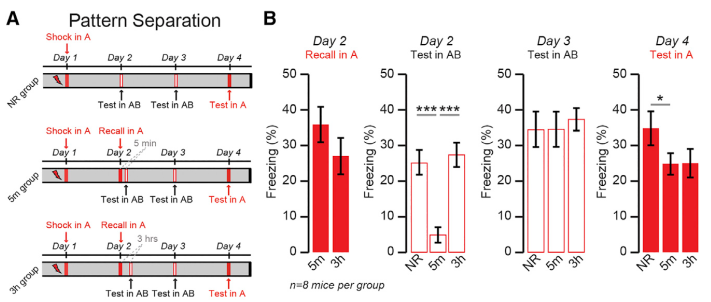
- on Day 3, all groups showed robust and similar levels of freezing
- Result held for AB exposure 1 hour after exposure to A
- Takeaway: Reactivating memory of context A within 5 minutes of context AB causes mouse to freeze less
Exp 3 (Behavioral)
- Day 1: Expose all mice to context A without shock
- Day 2: Mice either not shown context A (no recall) or recall (either 5min, 1 hr or 3 hr)
- Day 2: Half of all three groups then shocked for 5s and other half shocked for 10s
- Day 3: test fear response
- All mice with 10s shock showed more freezing than mice with 5s shock
- Mice with 5m recall or 1hr recall had higher freezing than no recall mice and 3hr recall mice
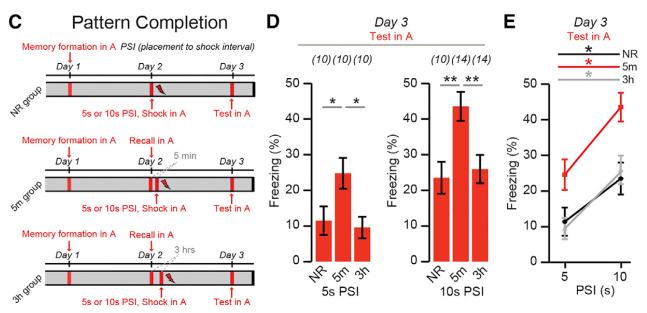
- Takeaway: excitability correlates with easier retrieval of fear memory
Exp 4 (Cellular, Neural, Behavioral)
- Is the previous result causal? That is, does excitability enable easier retrieval of fear memory?
- Kir2.1 prevents this short term excitability
- TODO: how to interpret 4D? I can’t find what difference is between RFP and Kir2.1
- Impairing short-term excitability decreased ability to recall memory (4E)
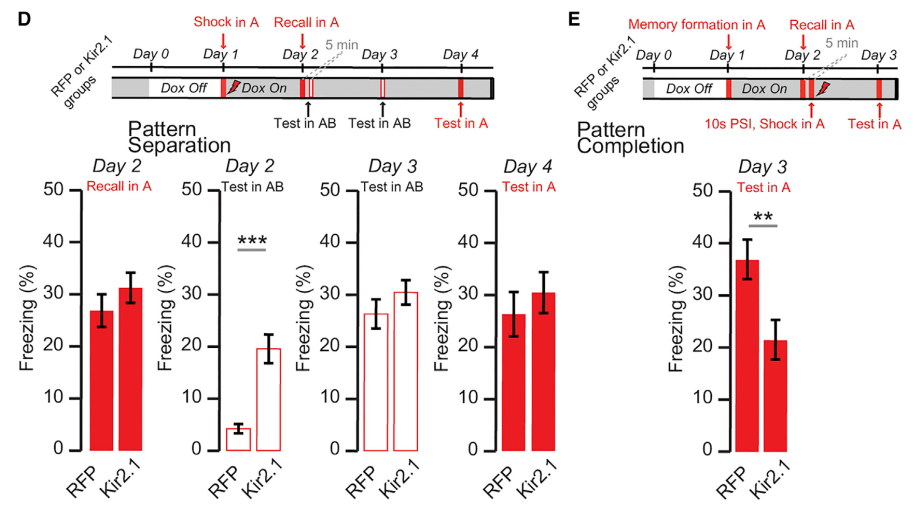
- Effect did not hold for different context C, displaying context-specificity
- Takeaway: excitability allows for easier retrieval of fear memory