Learning to Understand Phrases by Embedding the Dictionary
Background
Semantics, the linguistic study of meaning, has at least two subfields: (1) lexical semantics, which concerns how the meaning of word acts in grammar in composition as well as how different uses of a word relate, and (2) phrasal semantics, which concerns the meaning of syntactic units larger than a word (e.g. a phrase, a sentence, a paragraph).
Research Questions
- Can we train neural language model to map words to definitions and vice versa?
Approach
- Train Word2Vec on 8 billion words from large corpus with 500 dimensional embeddings
- Consider three models (RNN, LSTM, Bag of Words), each with own randomly initialized embedding, and train to output the Word2Vec embedding of a word given the word’s definition.
- Consider 2 losses: (1) cosine distance, and (2) rank loss, where \(c\) is the test word, \(s_c\) is the definition sequence, \(M(s_c)\) is the language model’s output, \(v_c\) is the pretrained embedding from Word2Vec and \(v_r\) is the pretrained embedding of a randomly selected word:
Experiment 1: Reverse Dictionary
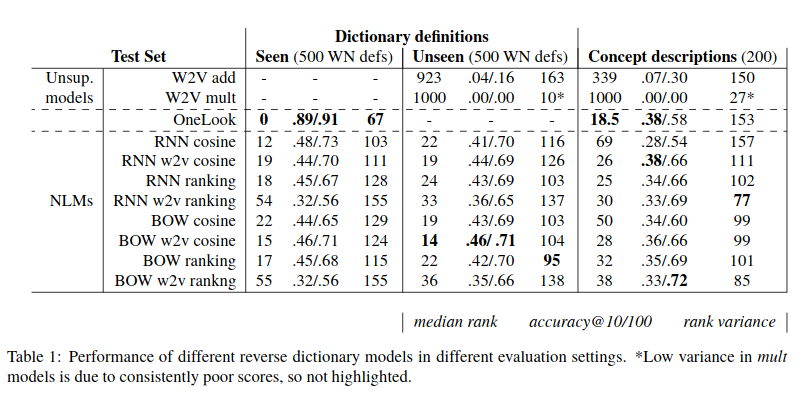
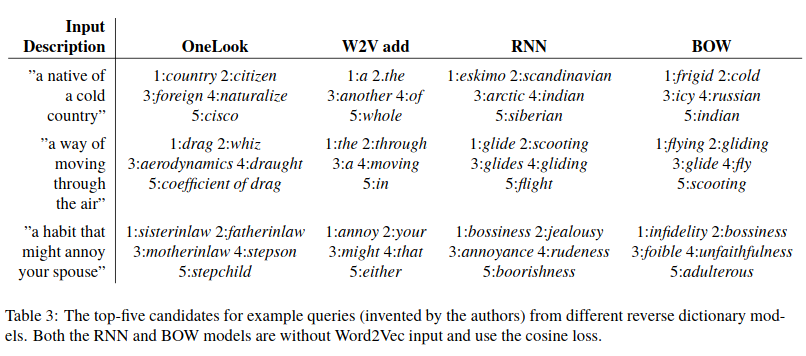
- Compare neural models against online tool OneLook, which is a reverse dictionary: given a sentence, return a list of candidate words
Experiment 2: Crossword Solving
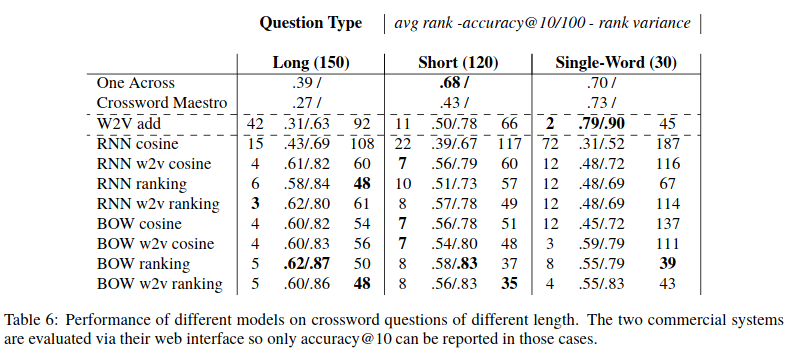
- Compare neural models against Word2Vec addition and online tool OneAcross